
Landing before battery voltage drops too low prevents premature quad crashes and protects expensive LiPo packs from permanent damage.

This guide expands the Week 5 power-system plan into a practical article for FPV pilots who want fewer mismatched parts and safer battery habits. The goal is not to memorize every number. The goal is to understand what each number changes when the quad is armed.
The Practical Meaning
Low Voltage Cutoff and Battery Telemetry: Setting Up OSD Warnings in Betaflight sounds like a spec-sheet topic, but in a real FPV build it is a flight-feel topic. A motor, ESC, propeller, and LiPo battery do not work as isolated parts. They form one power system. Change one part and the quad can feel smoother, hotter, punchier, louder, more efficient, or less predictable.
For Betaflight battery voltage OSD warning, focus on the relationship between OSD voltage, current sensor, mAh used, sag, warning thresholds. These details decide whether the drone accelerates cleanly, lands with healthy battery voltage, and survives repeated practice without cooking motors or stressing the ESC.
What the Draft Is Pointing At
Landing before battery voltage drops too low prevents premature quad crashes and protects expensive LiPo packs from permanent damage.
Navigate to Power & Battery tab in Betaflight Configurator.
Set Minimum Cell Voltage to 3.3V and Warning Cell Voltage to 3.5V.
In OSD tab, enable Battery Voltage, Amperage Draw, and Mah Drawn.
The key is to avoid treating the biggest number as the best choice. Higher KV, steeper pitch, larger stator volume, more C rating, or higher charger wattage can all be useful, but each one adds load somewhere else. A good FPV power system feels boring on the bench and confident in the air.
How to Choose for Real Flying
Start with the aircraft size and mission. A lightweight micro quad wants low mass and gentle current draw. A 5-inch freestyle quad wants enough torque to recover from dives and carry an HD camera. A racing build wants consistent response with minimal sag. A long-range build wants efficiency, cool motors, and predictable voltage warnings.
Then match parts in order. Pick the prop size the frame is designed around, choose a motor size and KV that can turn that prop on your battery voltage, use an ESC with enough current and firmware support, and select batteries that can deliver the demand without dramatic sag. This order prevents many expensive compatibility mistakes.
| Check | Good sign | Problem sign |
|---|---|---|
| Before power | No prop contact, clean solder joints, correct polarity | Loose wires, nicked insulation, wrong connector |
| First hover | Motors sound even and land cool | Grinding, twitching, fast heat buildup |
| Battery review | Cells end close together and voltage recovers | One cell drops hard or pack puffs |
| Next change | Only one variable changes at a time | Props, filters, ESC firmware, and battery all change together |
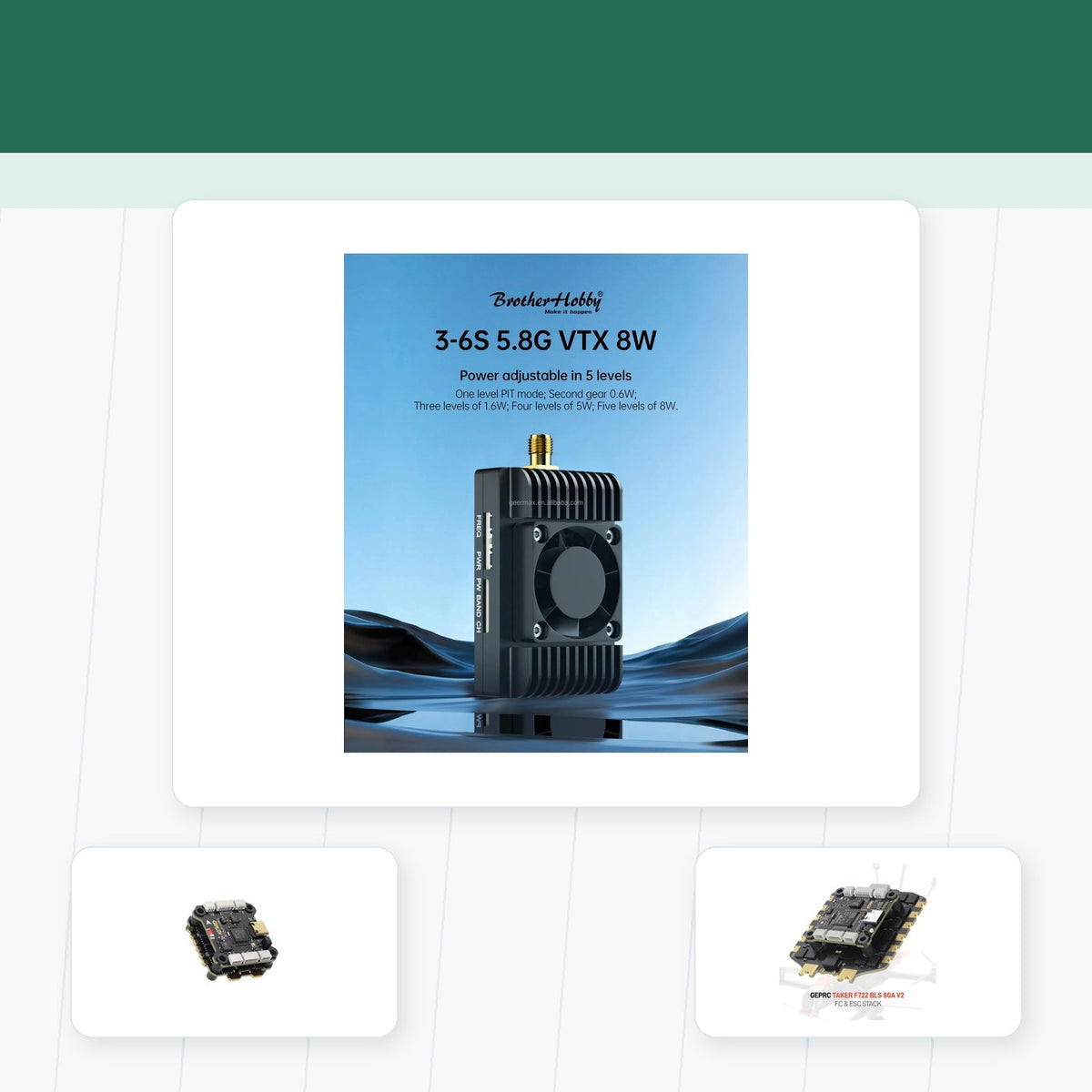
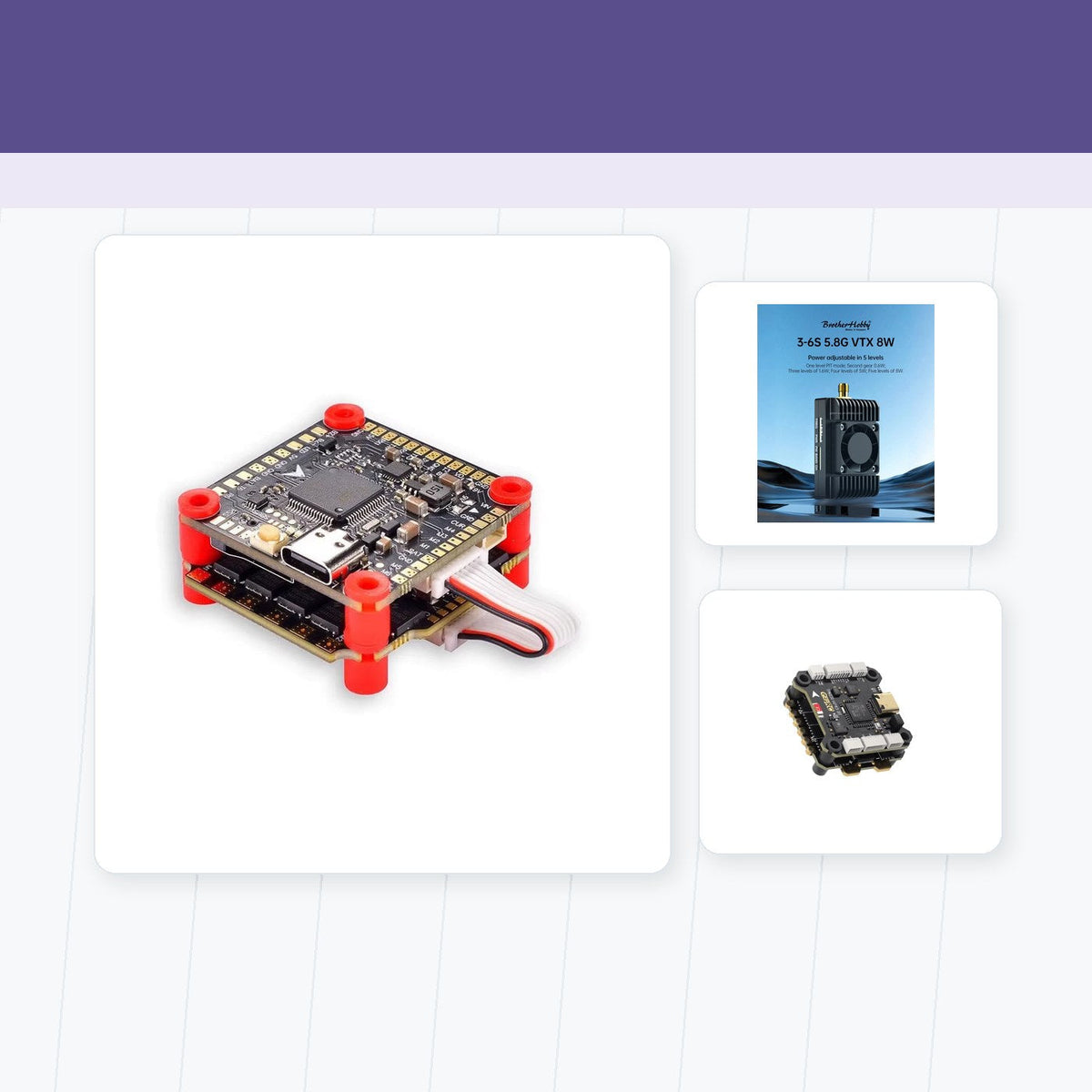
ESC settings only behave well when the hardware is sized correctly. Compare FC and ESC stacks and the F722 60A FPV stack when you need a clean 2-6S power system for a repair or fresh build.
Setup and Testing
Make the first test boring. Remove props for bench work, check polarity before plugging in a LiPo, confirm motor direction, and save the current Betaflight configuration before changing firmware or filters. After the first hover, land early and touch each motor. Warm is normal; painfully hot is information.
If the aircraft behaves badly, change one variable at a time. Swap to a known good prop, inspect motor screws, check for bent shafts, verify ESC protocol, then look at filtering or PID changes. Random tuning hides the cause. Controlled testing teaches you what the quad is actually asking for.
Common Mistakes to Avoid
- Buying motors before deciding prop size, battery voltage, and frame use.
- Assuming advertised battery ratings always reflect real-world discharge performance.
- Ignoring motor temperature because the quad still flies well for one pack.
- Changing ESC firmware or PWM frequency without writing down the previous working setup.
- Charging or storing LiPo packs in a hurry instead of using a repeatable safety routine.
Field Takeaway
The best setup for Betaflight setup, long range, beginner landings is the one that stays consistent from the first minute to the last. You should know how the motors sound, how the battery sags, how the props load the drivetrain, and how the ESC behaves after a few hard throttle moves. When those signals are predictable, tuning becomes easier and crashes become less mysterious.
Use this Week 5 topic as a buying filter and a maintenance habit. If a part improves real control, stays cool, and matches the rest of the build, it belongs on the shortlist. If it only looks powerful on paper, slow down before adding it to the cart.
Share:
Why ESC PWM Frequency (24kHz, 48kHz, 96kHz) Changes Your Flight Feel
How to Solder ESC Motor Wires: Step-by-Step Soldering Guide