
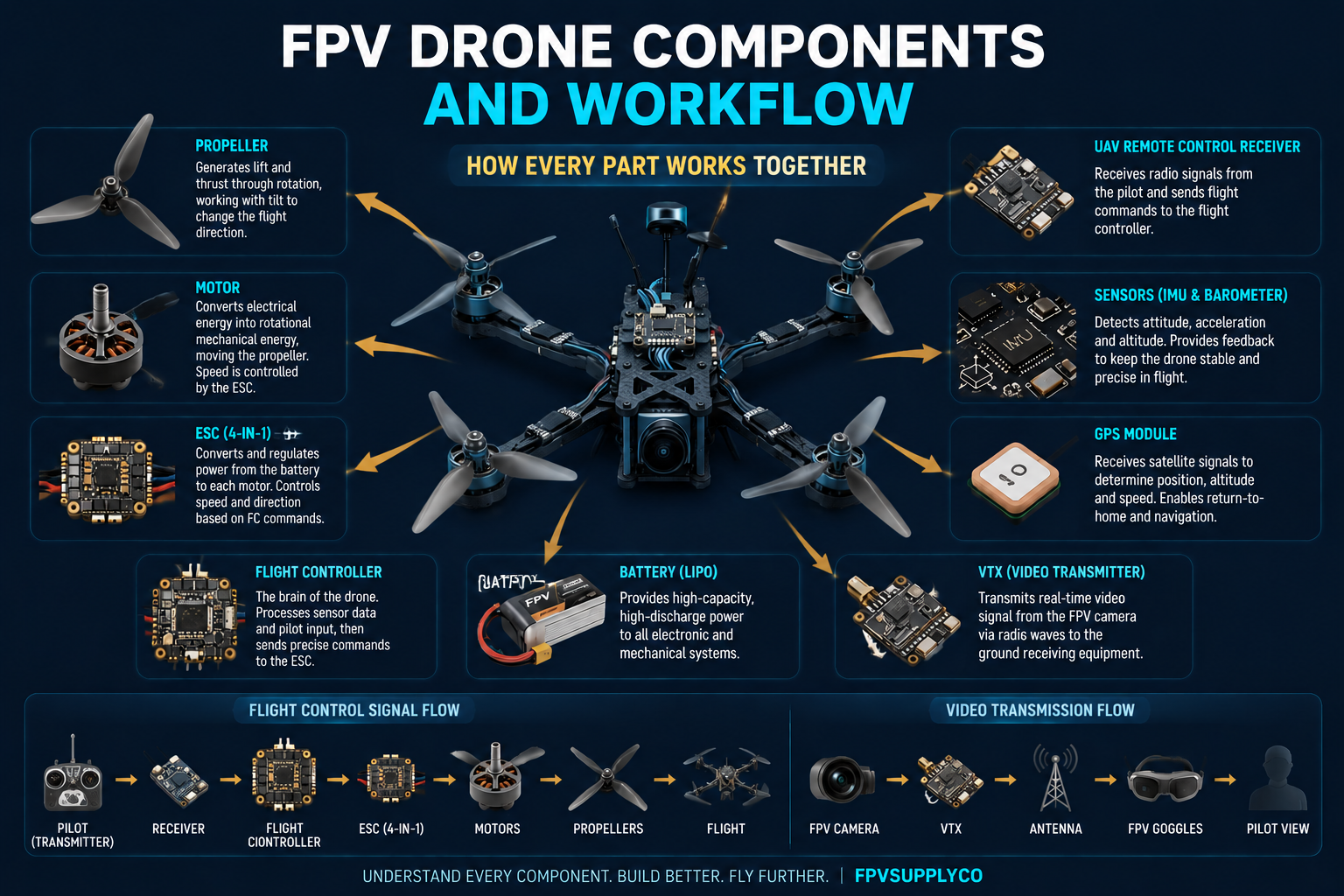
FPV Drone System Overview
An FPV drone works through a continuous control loop:
Pilot Input → Radio Receiver → Flight Controller → ESC → Motors → Propellers → Drone Movement
At the same time:
Camera → Video Transmitter (VTX) → FPV Goggles/Monitor → Pilot
The drone uses sensors and processors to constantly measure movement and automatically adjust the motors to maintain stability.

1. Propeller — Converting Rotation into Thrust
Working Principle:
The propeller is the component that directly generates lift and movement.
When the motor spins the propeller:
- The curved blades push air downward
- According to Newton’s Third Law, the drone is pushed upward
- Different propeller angles change thrust, speed, and efficiency
Propeller Characteristics:
Pitch
- Higher pitch = more speed and aggressive response
- Lower pitch = smoother control and efficiency
Blade Count
- 2-blade props: efficient and fast
- 3-blade props: balanced freestyle performance
- 4+ blade props: more grip and control
The propeller transforms the motor’s rotational energy into flight power.
2. Brushless Motor — Creating Mechanical Power
Working Principle:
FPV drones use brushless motors because they provide:
- High efficiency
- High RPM
- Fast response
- Long lifespan
A brushless motor works by using electromagnetic forces.
The ESC sends electrical pulses to the motor coils:
Electrical Energy → Magnetic Field → Rotor Rotation → Propeller Movement
Motor specifications:
KV Rating
KV represents RPM per volt.
Example:
- 2207 1750KV motor:
- Lower KV
- Suitable for higher voltage batteries
- 2207 2600KV motor:
- Higher RPM
- Suitable for aggressive freestyle builds
3. ESC (Electronic Speed Controller) — Motor Control System
Working Principle:
The ESC acts as the bridge between the battery and motors.
It receives signals from the flight controller and controls:
- Motor speed
- Current flow
- Acceleration response
The process:
Battery Power → ESC → Controlled Electrical Pulses → Motor Speed
Modern FPV drones commonly use:
- 4-in-1 ESC boards
- BLHeli firmware
- High-current MOSFET circuits
The ESC allows every motor to accelerate or slow down independently.
4. Flight Controller — The Brain of the Drone
Working Principle:
The flight controller is the central processing unit of the drone.
It collects data from:
- Gyroscope
- Accelerometer
- Barometer
- GPS
- Receiver
Then it calculates motor corrections hundreds of times per second.
Example:
If the drone tilts forward:
- IMU detects the angle change
- Flight controller calculates correction
- ESC increases/decreases motor speeds
- Drone returns to stable flight
The flight controller runs firmware such as:
- Betaflight
- iNav
- ArduPilot
5. IMU Sensors — Measuring Drone Movement
Working Principle:
The IMU (Inertial Measurement Unit) contains:
Gyroscope
Measures:
- Rotation speed
- Roll
- Pitch
- Yaw movement
Accelerometer
Measures:
- Linear movement
- Gravity direction
The flight controller uses this information to maintain stability.
Without IMU feedback, an FPV drone would be almost impossible to control.
6. LiPo Battery — The Energy Source
Working Principle:
FPV drones use lithium polymer batteries because they provide:
- High discharge current
- Lightweight design
- High energy density
Battery specifications:
Cell Count (S)
Examples:
- 4S battery = 14.8V
- 6S battery = 22.2V
C Rating
Shows discharge capability.
Higher C rating:
- More power output
- Faster acceleration
Energy flow:
Battery → Power Distribution → ESC → Motors + Electronics
7. Radio Receiver — Connecting Pilot Commands
Working Principle:
The receiver captures signals from the pilot’s transmitter.
The communication process:
Radio Controller → Wireless Signal → Receiver → Flight Controller
Common FPV receiver systems:
- ExpressLRS (ELRS)
- TBS Crossfire
- FrSky
The receiver sends:
- Throttle commands
- Roll commands
- Pitch commands
- Yaw commands
- Switch commands
8. FPV Camera — Capturing the Flight View
Working Principle:
The FPV camera converts the environment into a video signal.
Types:
Analog Camera
- Low latency
- Simple system
- Popular for racing
Digital Camera
- Higher image quality
- HD transmission
- Better viewing experience
The camera sends video data to the VTX.
9. Video Transmitter (VTX) — Sending Live Video
Working Principle:
The VTX converts camera signals into radio waves.
Process:
Camera Signal → VTX → Antenna → FPV Goggles
Important VTX features:
- Transmission power (mW)
- Frequency bands
- Digital or analog system
Higher power provides longer range but consumes more energy.
10. GPS Module — Position and Navigation
Working Principle:
GPS receives satellite signals to calculate:
- Location
- Speed
- Altitude
- Direction
GPS enables advanced functions:
- Return-to-home
- Rescue mode
- Navigation
- Long-range safety features
Complete FPV Signal Flow Diagram
          PILOT
            |
            ↓
     Radio Transmitter
            |
            ↓
     Receiver Module
            |
            ↓
     Flight Controller
            |
     ----------------
     |              |
     ↓              ↓
    ESC          Sensors
     |
     ↓
  Brushless Motors
     |
     ↓
 Propellers
     |
     ↓
   FLIGHT
Video System:
FPV Camera
     |
     ↓
 Video Transmitter
     |
     ↓
 Antenna
     |
     ↓
 FPV Goggles
     |
     ↓
 Pilot Vision
How All FPV Components Work Together
An FPV drone is a combination of:
| Component | Main Function |
|---|---|
| Propeller | Generates thrust |
| Motor | Produces rotation |
| ESC | Controls motor power |
| Flight Controller | Processes flight data |
| IMU | Measures movement |
| Battery | Supplies energy |
| Receiver | Receives pilot commands |
| Camera | Captures video |
| VTX | Transmits video |
| GPS | Provides positioning |
Every component has a specific role, but the drone only works when all systems communicate together.
Build Smarter with FPVSUPPLYCO
Whether you are building your first FPV drone or upgrading a professional racing machine, understanding component principles helps you choose the right parts and achieve better performance.
From motors and ESCs to flight controllers, batteries, cameras, and VTX systems, FPVSUPPLYCO provides the essential components for every FPV pilot.
Master the technology. Build with confidence. Fly beyond limits.
— FPVSUPPLYCO Team
Share:
Elevating the Skies: Welcome to FpvSupplyco – Your Ultimate Partner for High-Performance Drones, Wholesale & Custom Drone Light Shows