
Analog FPV is still alive because it is light, repairable, and predictable. High-output analog VTX modules add range and penetration, but the best choice depends on cooling, control protocol, connector type, and how hard you fly.

What Makes a Good High-Power VTX
Power output matters, but filtering, thermal design, channel stability, mounting pattern, antenna connector, and control protocol matter too. A noisy or overheated VTX can create a worse experience than a lower-power unit installed cleanly.
For FPVSupplyCo builds, compare options inside FPV video transmitters and match the transmitter to the frame space and antenna plan.
Buyer Priorities
| Feature | Why it matters | Ideal for |
|---|---|---|
| 800mW+ | More margin for distance and light obstacles | Outdoor freestyle and exploration |
| Large heatsink | Reduces thermal stress at high power | Long flights and hot climates |
| SmartAudio or Tramp | Changes channel and power from Betaflight | Fast field setup |
| MMCX or SMA output | More durable antenna connection | Crash-prone freestyle frames |
Strong Options to Consider
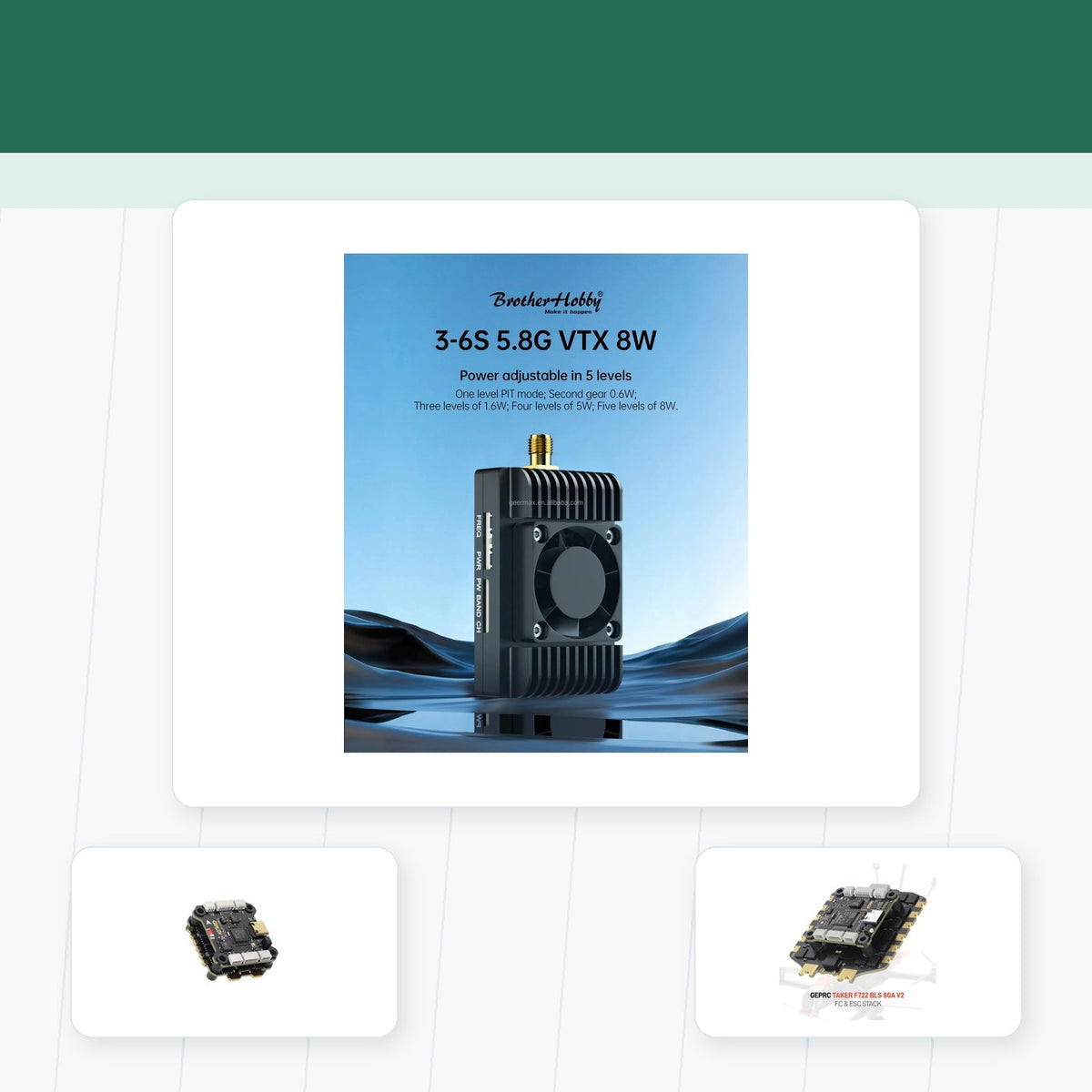
The 2.5W high-power FPV video transmitter is a practical high-power analog option for pilots who want strong 5.8GHz output with a serious heatsink.
The 3W ultra-power FPV video transmitter fits pilots who need extra output headroom for demanding analog range use. The dual-band 4.9G/5.8G FPV video transmitter and 5W long-range FPV video transmitter are more specialized choices for pilots planning non-standard long-range video setups.
Avoid These VTX Mistakes
- Running high power on the bench without airflow.
- Using the wrong antenna connector or a damaged pigtail.
- Mounting the VTX where the battery blocks the antenna.
- Flying high power near other pilots without coordination.
The Real Verdict
Buy the VTX that suits your frame and environment, not just the highest wattage on the product page. Good antennas and clean mounting often add more usable range than raw power alone.
For most freestyle pilots, a durable 800mW to 2.5W class analog VTX with proper cooling is the sensible high-output path.
Further Reading
Practical Checklist for Top Analog VTX Modules with High Output Power
Use the following checklist to turn the comparison or procedure in this guide into a repeatable decision. Start with the equipment and conditions you actually use, document the current working state, and avoid changing several variables at once.
- Confirm legal regional limits before treating maximum output power as a buying advantage.
- Match voltage input, camera format, antenna connector, channel control, and mounting space to the aircraft.
- Provide airflow and never power a high-output VTX without a suitable antenna attached.
- Compare pit mode, SmartAudio or Tramp support, thermal protection, and real power stability.
- Use staged range testing because antenna placement and interference often matter more than headline wattage.
How to Validate the Result
Define a clear success condition before testing. For Top Analog VTX Modules with High Output Power, that might be stable operation, lower temperature, cleaner video, more predictable control, easier maintenance, better compatibility, or a safer workflow. Record the starting configuration, complete one controlled change, and compare the result under the same conditions. If the outcome cannot be repeated, treat it as an observation rather than a proven improvement.
Photograph wiring and mounting, save configuration files, and note component models and firmware versions where relevant. These records are especially useful after a crash, repair, software update, or equipment swap. They also make it easier to explain the setup to another pilot, technician, or purchasing team without relying on memory.
Before relying on the result, repeat the test under representative conditions and record the hardware, firmware, settings, environment, and outcome. A known-good baseline makes future upgrades and troubleshooting faster because each change can be compared with evidence instead of memory.
Revisit this checklist whenever the aircraft, battery, video or control system, payload, software, or operating environment changes. Confirm manufacturer documentation and local requirements where safety, radio transmission, batteries, airspace, or professional operations are involved.
Share:
Best High-Gain Patch Antennas for FPV Long-Range Penetration
Walksnail Moonlight 4K Camera Kit: Is It Better Than GoPro?